Financing the Warneford – Early Sources of Funds
What are the origins of the Warneford Hospital?
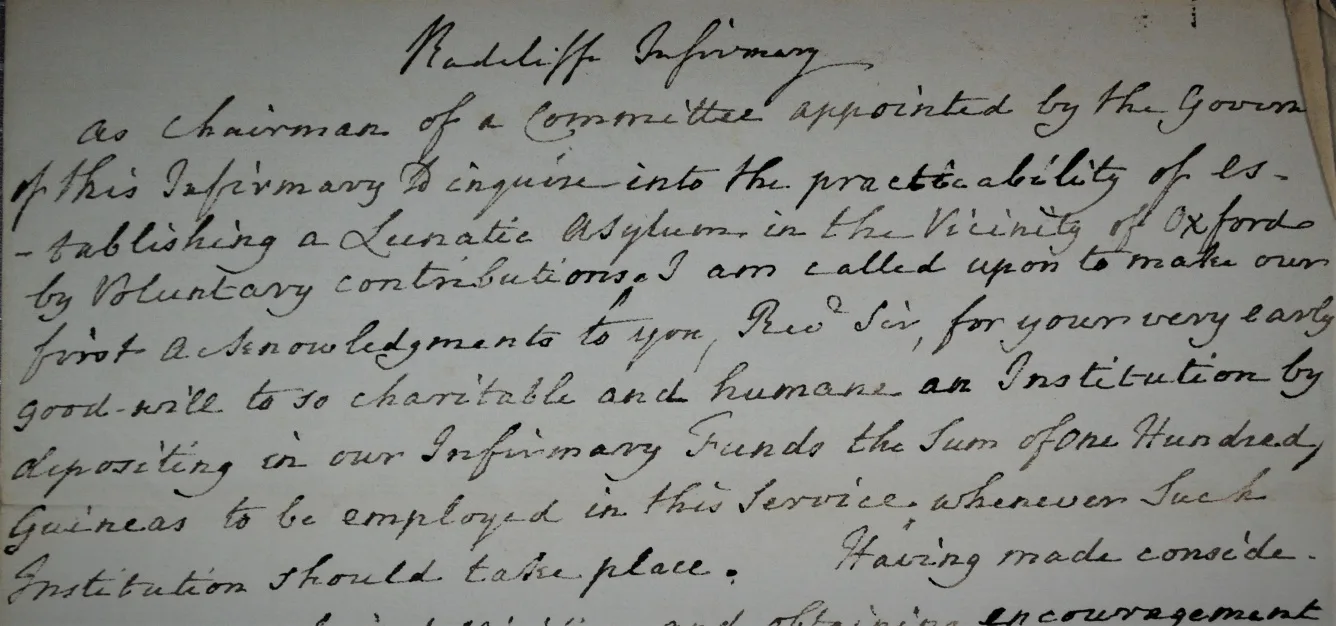
On 19 November 1812 a Board meeting of the Governors of the Radcliffe Infirmary ordered an advertisement for a public meeting to be held in December ‘to appoint a Committee for the purposes of procuring information on the practicability of erecting a Lunatic Asylum in the neighbourhood of Oxford’. The Governors had received an anonymous benefaction of 100 guineas in 1810, to be used ‘towards the establishment and support of an asylum for lunatics in the county of Oxford’. This benefactor was later identified as the Rev John Vye of Wootton, Northamptonshire. It seems a pity that virtually no-one knows his name now, although the foundation of the asylum appears to have been his idea.
A public meeting duly took place and appointed a committee, principally composed of members of the University. After 4 meetings it was decided that the Asylum should be separate from the Radcliffe Infirmary, though under the general direction of its Governors. The Infirmary Governors accepted the trust and the responsibility.
A public appeal was launched and an architect requested to survey a piece of ground next to the Radcliffe Infirmary. In the end this site was not used, and neither were the alternatives opposite the Radcliffe Observatory and in Jericho. Eventually a site in Headington was purchased, cheaper than the Oxford sites and with greater possibilities for expansion. A further plot was purchased in 1821 and the Committee of Management of the Hospital continued to buy up surrounding land at every opportunity.
As the building started the Committee took all the advice they could find, writing to other asylums, experts and prominent professionals. There are many letters in the archives, giving advice on care of patients, food, exercise and building design.
The original target of the appeal was £20,000 and over a third of the sum raised was contributed by the University and the colleges. The cost of the building was far greater than had been anticipated and only £400 was left to the Committee by the time the asylum opened its doors in July 1826. This was to be the first of many appeals for funds authorised by the Committee.
The asylum was originally named the Radcliffe Asylum. It was renamed the Warneford in 1843 in honour of its greatest benefactor Samuel Wilson Warneford (1763-1855), who gave property and financial donations to the value of over £70,000 to the Asylum during his lifetime, amounting to £10 million pounds in today’s terms.
Who did the Warneford Hospital cater for?
The asylum was to be for those of the middle classes and paupers were specifically excluded. This may seem harsh, but in fact the committee were aiming to plug a gap. The wealthy could afford private keepers, as they were known, and the poor were provided for by the Poor Law, however inadequate that may have been in our eyes. In the middle were the genteel middle classes, the clergy and professionals, who were frequently neither rich enough for private care or poor enough to apply to the parish. The idea was that a sliding scale of charges would be drawn up which enabled those who could pay something to provide care for their relatives at rates they could afford. In due course a fund for poor patients was established; donations and surpluses were invested and the profits went towards poorer patients. This was especially helpful in the case of those who would otherwise have had to be discharged because they were unable to continue with their weekly payments. When the Asylum was being built there was an attempt to involve the county magistrates who were ultimately responsible for paupers but they were reluctant to contribute at a time of high expenditure on highways and bridges and so paupers were excluded. An Asylum for pauper lunatics was finally opened by the county in 1846 at Littlemore.
The wealthy could afford private keepers… and the poor were provided for by the Poor Law.
Between July and December in the first year 11 patients were admitted, paying between 12/- and 2 guineas a week according to their family resources and the sort of accommodation they had in the asylum. The patients were all supposed to be of the middle classes, but they were still classified within the asylum. There was different accommodation inside the building for the superior class, 2nd class and 3rd class, and this was continued outdoors, where each class had its own walled ‘airing court’ for exercise. The superior class were at the front of the building, the 2nd class at the side and the 3rd class at the back, near the wash house and the kitchen. Men and women were strictly segregated; there was a male side of the hospital and a female side, and this continued well into this century. Most of the first 11 patients were local but the asylum was not restricted; one patient was from London and one from Camarthen. The patients generally fitted into the expected categories and included a tailor, a lace maker, a farmer, a weaver, a law student, a gentlewoman and, perhaps surprisingly, a labourer. In due course 9 of the 11 were discharged cured or relieved.
How did the Warneford Hospital finance itself?
It is very early in the history of the asylum that the figure of Samuel Wilson Warneford appears on the scene. He was born in 1763, went to University College here in Oxford and was ordained in 1787. He started his clerical life in Brize Norton and eventually settled with his wife in the rectory at Bourton on the Hill in Gloucestershire. His wealth came from the families of his mother and his wife. His life long friendship with Vaughan Thomas, the vicar of Yarnton and for over 30 years Chairman of the Asylum’s Committee of Management, probably helped to keep the cause close to his heart.
We first encounter him in 1828, when he expressed a desire to create a trust to be responsible for the Asylum’s lands. In 1831 and 1832 a boundary wall was placed around the grounds and this was paid for by Warneford. The desire to stare is nothing new and the grounds had become a popular resort for the curious from the city. Warneford’s really substantial benefactions begin in 1838, when he vested £4000 in a Trust for the Asylum’s benefit. He followed this up by giving lands to the Asylum, the rents and other incomes of which would create a steady and regular income. In 1843 he gave an estate in Sussex and later added more lands there and other property in Surrey, Kent, Middlesex and London. Further estates were given in 1851, in which year he also endowed an annual stipend for a chaplain.
The grounds had become a popular resort for the curious from the city.
Warneford was responsible for obtaining a royal charter for the Asylum in 1849, an important step as it made the Governors into a Corporate Body. A Body incorporated by Charter had the right to act as though it was one individual (properties has previously been granted to individuals on behalf of the Asylum) and had freedom to look after its own affairs without any liabilities. As if all this wasn’t enough Warneford contributed generously to the various building schemes which enlarged the Asylum over the years. It is hardly surprising that the Asylum was renamed the Warneford Asylum in 1843 and that the Governors decided that the corporate seal to which the charter entitled them should portray Samuel Warneford in the act of handing over the charter.
However, the benefactions did have some disadvantages; fund raising appeals were often ignored by the public because of a widespread belief that the asylum had a large sum invested for use when they chose, whereas in fact the rules forbade them to speculate on future income – they could only use each year’s as it came.
The Warneford became involved in a number of disputes over the years and took a firm stand on its position as an independent charity. As the Lunacy Laws became more complex Parliament tried to apply them to all asylums, but the Warneford was one which refused. To have agreed would have meant regular visits of inspection by the County magistrates, the very people who had refused to contribute to the Asylum in the early days.
Lucy Barrell, Oxfordshire Health Archives, Dec 2021