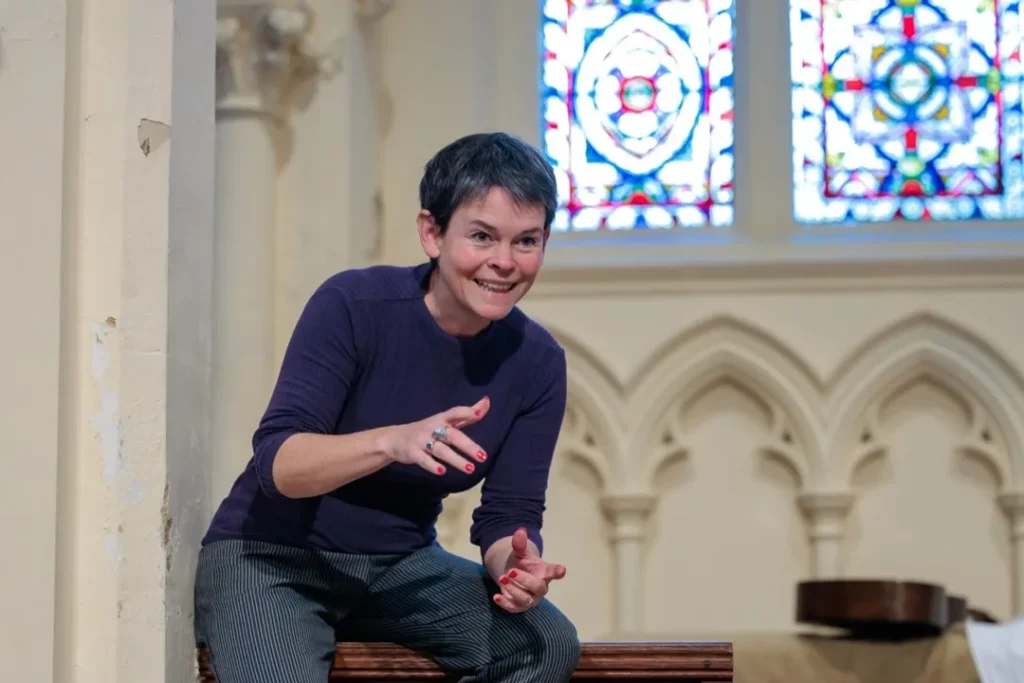
A blog post by Within These Walls Director, Anna Tolputt
I had lots of sad stuff going on in my life when I lay down on my mum’s lawn to read the first draft of “The Warneford”. It landed me slap bang in the world of Dr Wintle and his discretely terrifying wife, Matron, as they showed a visitor around their mental asylum. The Wintles’ marital subtext ran explosively underneath a formal presentation of their family concern (“a much better class than Littlemore”) punctuated by the sound of a background riot. It wasn’t the obvious choice for much-needed escapism but here I was, laughing out loud. I wasn’t prepared for the sting in the tale when Dr Wintle wheeled out one of the patients as a test case, a woman who had been sectioned indefinitely by her own husband for postnatal depression. Bolam’s ability to twist the knife in the middle of comedy is merciless. I was furious when the scene ended and we abandoned the Lucy Osborne to time.
The play started off as a patchwork quilt of dramas, “a series of vinaigrettes” as Janet likes to call them, a malapropism which has the advantage of being quite descriptive as they are both sharp and sweet. Despite the bleakness of the setting and the stories within it, there is sense of human spirit in the darkness, a connection. Jokes can be made in the middle of the most horrendous suffering.
Janet has drawn strongly on excellent research provided by Jane Freebody as well as hands on experience from Gillie Ruscombe King. What became more and more clear as we rehearsed and developed it was the theme of human connection in the curing of patients, alongside a sense of “there but for the grace of God”. It helped that we only had a cast of 4 (extraordinary) actors to portray dozens of characters. There was no distinction between carer and cared-for, they played both. And the simple power of a staff – patient human connection showed up across time, regardless of the systems of oppression bearing down on them.
It became clear that we needed a central relationship to develop through the play and this we had in the characters of Lucy and Stu, perhaps the most unlikely friendship ever formed.
At various points in time music has been employed in asylums as a form of “moral management” and Janet’s intentional music choices were invaluable for intensifying the mood. To complicate our own lives we decided that it should be provided by the “inmates” themselves. On more than one occasion, the script required an actor to be simultaneously onstage, holding a conversation with themselves performing a speedy period costume change, playing the guitar and entering from a different side of the building.
Despite this, the Warneford chapel where we rehearsed and performed, is imbued with a calm spiritual joy which I am convinced infected us. I’m sure we played “meet on the ledge” way more than we actually needed to. There was a sense that we were honouring the people across the years who have actually turned to this space for comfort. It was, strangely, one of the happiest, most creatively fulfilling rehearsal periods I have ever had. I hope that comes across. We owe it to the Warneford ghosts. And to my own personal ghost who kept me company along the way.
