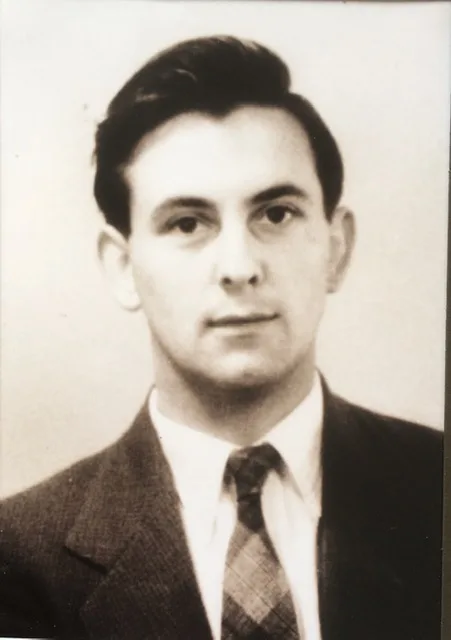
Roy Overall
Interviewed by Julia Buchanan
Biography
Roy Overall is a retired psychiatric nurse. He was interviewed by Julia Buchanan in December 2025. Roy was born in 1932 and grew up near Wantage. He started working at the Warneford Hospital in1952 as a student nurse after returning from National Service in North Africa. After completing his training, he worked on the in-patient wards for 20 years, through the 1950s and 60s, and then became one of the first Community Psychiatric Nurses at the Warneford, working for a further 20 years supporting people with long-term mental illness in out-patient clinics and in Group Homes. After his retirement in the 1990s, Roy was a greatly valued volunteer at the Oxfordshire Health Archive.
This excerpt
In this excerpt Roy describes how he came home to Wantage after completing his National Service with the Army in North Africa, without a plan for what he would do next. After visiting the Employment Office in Oxford, he had an interview with the Matron at the Warneford, and was offered a position to start in the next few days.
The full interview
Topics covered in the full interview include: Roy’s early education and National Service, the separate male and female “sides” of the hospital in the 1950s and early 60s, then later re-organisations and integration of both sexes in the wards. He describes treatments and medicines which were used at different periods; also initiatives to move long-term mentally ill patients out of hospital. Roy describes the leading role which he had in the conversion of St. Gabriel’s House in Hill Top Road for use for out-patient clinics, living accommodation for patients moving out of hospital, and accommodation for the screen-printing group which was a therapeutic and rehabilitation activity for patients. Roy has a deep knowledge of the buildings and extensive grounds of the Warneford site. He has a life-long interest in ornithology and sometimes carried out mist-netting and ringing of birds in the Warneford grounds. The full interview recording and transcript can be accessed at Oxfordshire Health Archives.
Transcript of audio excerpt
00:20:35 Roy Overall
I mean, one thing that was told to us was – if you go in the Army or Navy or Air Force you learn a trade – and I’d learned to type and things like that. But when I got out, of course, the thing hit me – there are no Signals operating units in civvy street. I mean, the computers they were about … So I was left in Wantage [then in Berkshire, now in Oxfordshire], which didn’t have much.
00:21:22 Interviewer (JB)
And this was 1952 then?
00:21:24 Roy Overall
This was, yeah, ’52, yeah. So I went to …I had a friend who was …she was one of my sister’s, they used to be in a choir together in Wantage, and she was some sort of Employment Officer or something. So I went to see her and we had a long chat and she said, “Well, I’ll tell you what,” she said, “Why don’t you go to the Employment Bureau in Oxford, and I can give you a note to them, and see what they can do for you?” So I went on the bus, great. I was getting a bit fed up with Wantage – I’d seen all the films and things like that, and a lot of the people I was at school with, they’d either gone off in the Army, or else they were still at school, and I didn’t really mix with them because they were two years later, actually.
So I went to see this chap and he said, “Well, yeah.” So we talked about it. I’d seen an advert in one of the papers about it. And he said, “Well, first of all, there are two mental hospitals in Oxford. One I know nothing at all about, it’s outside Oxford, it’s called Littlemore. I don’t even know which bus goes there. But the one I do know about is the Warneford. And the bus actually stops just outside here in Cornmarket [Oxford city centre].” And he said, “You could catch it and go there.” So I said, “Yeah, okay.” So he rang up the Matron and asked for an appointment. And she said, “Yes, send him up.”
I caught the next bus and then went in, met her … she put me in the front waiting room, which was kept for visitors, you know, and it was beautiful. Well, you’ve been in that front waiting room on the left hand side, yeah, and you’ve seen Warneford Sammy [statue of Samuel Warneford], and yeah, she gave me a long talk … And what we talked about most was being in the Army, because she had been, during the war, which had just finished, she’d been a nurse, a Matron in the Army, Nursing Corps, and so we had a lot in common, and she’d actually been in the Canal Zone [Suez Canal], and so we had a lot to talk about.
And in the end, she said, after about an hour’s conversation, it was very nice, you know, she said, “Right, Mr. Overall, when can you start?” I said, “Well, you haven’t asked me about any qualifications or any references, anything like that.” “No,” she said, “When can you start?” Afterwards I thought about it, she’s either desperately short of nurses or she can see something in me that I can’t see.
Anyhow, she said, “Well, when can you start?” And I said, “Well, what about next Sunday?” “Yes, that would do fine. I’ll have another student nurse to meet you.” My father would bring me up there. And I met her, we went to the front waiting room, had this interview, and she said, “Right, well, you’ll start, and I’ll have a student nurse meet you, take you to the dining room, you’ll have supper, he’ll show you to your bedroom, and just a little bit, he’ll show you the ward that you’ll be working on.” And so that was that.
00:25:05