By Dr Joseph Baskerville-Butler and Dr Lydia Thurston
Following the launch of W200 in January 2026, Psychiatrists Dr Joseph Baskerville-Butler and Dr Lydia Thurston wrote this piece for the History of Psychiatry Special Interest Group (HoPSIG) newsletter, issue 22. This is a lovely introduction to the Warneford 200 programme which we wanted to share. The article has been re-produced with the kind permission of the editors.
You can read this and other issues of the HoPSIG newsletter on the Royal College of Psychiatrists’ website.
Issue 22 includes other articles that may also be of interest:
Dr John Hall: Psychiatric research in Britain in 1952 (p32)
Dr Joseph Baskerville-Butler: Medical electricity at the early Warneford; where the Galvanic met the Galenic (p53)
It is often said that the past is a foreign country, yet nowhere does that feel more tangible than within the storied halls and corridors of the Warneford Hospital. For two centuries people have passed through its doors, encountering the same varied manifestations of mental illness. Some arrive unwillingly. Care and treatment are offered. Many recover; most find succour and in time, all move on – one way or another. It is this unbroken thread that is being marked and explored in ‘Warneford 200’, an exciting, year-long programme to commemorate the hospital’s bicentenary. As two psychiatrists who are very familiar with its corridors, we have been fortunate enough to be involved in the project which includes a travelling and online exhibition, talks, creative projects, as well as a drama and documentary film1.
Why mark the two-hundredth anniversary of the Warneford? It is a good question, given the project’s National Lottery Heritage grant funding. The Warneford is the oldest inpatient unit still in use across the entire NHS estate2. Its walls have witnessed the rise and fall of successive approaches to mental healthcare; from humoral medicine and moral treatment to shock therapy and psychosurgery, psychopharmacology, psychology, community care, the Mental Health Act and latterly the ‘MDT’. Perhaps uniquely, this care has all been delivered within the same physical setting. Not only does this allow us to trace how contemporary mental health services evolved, but it also allows critical reflection upon them: how else are we to improve services over the next two hundred years?
There is public interest. Discussions around the tensions between providing care, preserving autonomy, and balancing consent and dignity with safety and security are just as relevant in 2026 as they were in 1826. And unfortunately, ongoing stigma around severe mental illness still requires public engagement and the promotion of lived experience.
The Exhibition
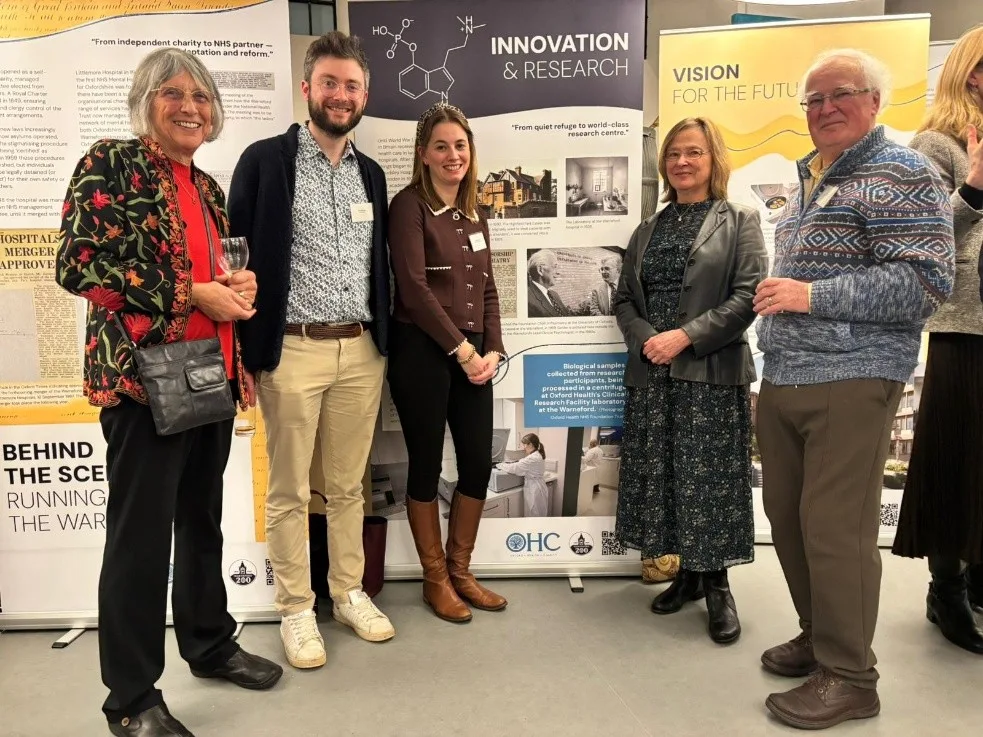
The programme kicked off with the opening of the Warneford 200 Exhibition at the Museum of Oxford on 15th January 2026. The event was a gathering of all those who had been involved in and supported the project and was a chance to share reflections and discoveries. The evening started with a chance to look at the exhibition and to marvel at some of the artefacts on show. Our personal favourites were the menu (on the 20th of November 1949, the patients had for dinner: soup, roast sirloin, Yorkshire pudding and potatoes, followed by trifle and cream), cupping glasses for extracting blood and one of the first Electro-Convulsive Therapy machines. Audio guides captured the first-hand accounts of people admitted to the Warneford over the last forty years.
The opening of the exhibition was followed by speeches from Dr Karl Marlowe (CMO of Oxford Health NHS Foundation Trust), and Dr Jane Freebody, a historian who has played an integral role not only in research for the project, but also in its organisation, management and fundraising. Also in attendance were Dr Tina Eyre from the Oxford University Museum of the History of Science, who provided curatorial input and Kati Lacey, who designed the exhibition banners. The speeches were followed by Pippa Breeze, who performed thought provoking and evocative poems about her lived experience of mental illness. The evening closed with a screening of the history of the Warneford film, specially commissioned to tell the Warneford’s story. It includes excerpts from a play titled ‘Within These Walls’ by Janet Bolam, which has also been created in aid of the project and is based on case studies taken from the hospital archives.
Two hundred years of Mental Health Care
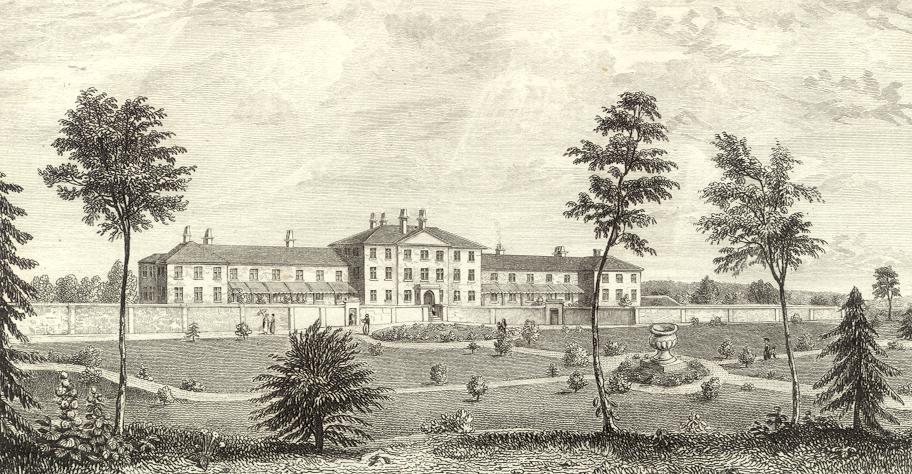
About two miles away from the launch, up Headington hill, the Warneford Duty Doctor would have been sat fatigued in the Doctor’s Mess, handing over to their night colleague. But before it was the doctor’s mess, it was the superintendent’s office, and before this it was farmland. At that time (the early 1800s), most of Headington’s income came from the limestone quarries that built the University of Oxford. It was Headington stone, that in 1812 a committee of gentleman of the University decided to use again, this time to build the Oxford Lunatic Asylum3, a place of “relief” for those of “respectable and educated life”. The rural Headington site, overlooking the dreaming spires was chosen for its peace, quiet and separation from the city. Hospitals then, as now, require capital investment and expertise. £20,000 was raised through public subscription and donation, with the University of Oxford donating around a third4. Much of that expertise was sourced, or given, by the Reverend Vaughan Thomas who was initially a subscriber, then a member, and then the chair of the Hospitals Management Committee5.
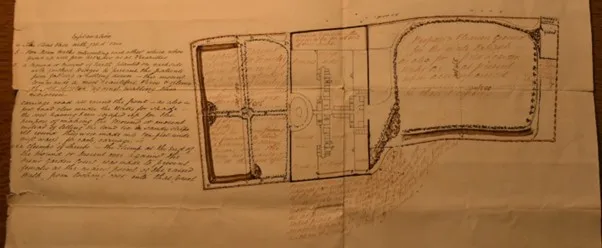
Prior to the opening, he wrote to asylums and to experts across the country to inform the Warneford’s design and practice, and he pored over plans. So much so that the archives are full of his handwritten letters and scrawls. He was particularly focussed on the Asylum’s gardens, writing how to make the tree-lined arcades more like Versailles, how to place the viewing mound to command the most beautiful view, and the precise locations for the Grecian vases and classical sculpture6. Vaughan Thomas’ intuition on the importance on the natural environment in insanity mimics modern research on the relationship between greenspaces and wellbeing.
Through the asylum, Vaughan Thomas embarked on a long friendship with Reverend Samuel Warneford7. Warneford, rich through inheritance and his marriage to a wealthy landowning MPs daughter, and possibly because of his wife’s insanity8, donated £80,000 (£7 million today) to the asylum over many years. In 1832 he paid for the twelve-foot stone enclosing wall which, like the building and his statue in the hospital reception, still stands today. In 1847 he paid for the hospital’s chapel and the endowment of a chaplain. The asylum was re-named in his honour in 1843.
People
In 1826, the Oxford Lunatic Asylum first opened its doors to patients. On the staff were a director, matron, two ‘keepers’ (providing day-to-day supervision of patients), three servants, two cooks, a laundry maid and three groundsmen. The management committee appointed Dr James Adey Ogle, the Aldrichian professor of Medicine at the University of Oxford, to oversee care.
At this time, the asylum was charitable but ‘private’ in the modern sense. There were three classes of accommodation. Patients paid for their room and care, which was informed by current medical practice and moral therapy; the progressive, activity-based management philosophy pioneered by the Tukes in York. Fees for poorer patients were subsidised by the fees of those wealthier and through public donation.
There were false starts. The first director was removed “unfit for the situation… owing to the state of his mind”. The second fattened his own pigs on the Warneford’s produce, displayed concerning bookkeeping and fed veal intended for patients to his dog. He was similarly let go4. Ogle then picked a young assistant apothecary from the nearby Radcliffe Infirmary, Frederick Wintle, to be the new director, who came to the Warneford alongside his wife Jane (who became the matron) in 18284. The Wintles and Ogle oversaw the first stable phase of the Warneford’s management, and as Wintle acquired more medical qualifications, Ogle withdrew from day-to-day medical responsibilities. The Wintles’ legacy remains relevant. He was a founding member and subsequently chair of the organisation that developed into the Royal College of Psychiatrists9; they give their name to one of the female inpatient wards at the Warneford and their great-great grandson, Professor John Hall was formerly the Warneford’s lead psychologist and is now on the HOPSIG editorial board and the W200 Project’s steering group.
Today and Tomorrow
Like all stories of the past, the Warneford’s origins only exist as we interpret it. The interpretation is dependent on the questions we ask about the past, which in turn are shaped by our present. One of the aims of the W200 project is to ask new questions of the Warneford and to uncover new stories.
Wintle, and later Dr Allen were supported by their wives as matrons. Given how ineffective medical treatment was for insanity, perhaps it was the compassionate care of the nurses and keepers, the activities and the safety and security provided by the building itself that was more important in patients’ recovery. The original rules for keepers (which are on display at the exhibition), if removed of their Christian overtones, are just as relevant now. The same cannot be said of the outdated medical treatments. What is distinctly missing is the accounts of patients, which W200 is rightfully foregrounding.
And so the work continues; both within the exhibition and at the Warneford itself. The archives, alongside other sources are still being systematically analysed by the exhibition team. The findings are being shared through short articles, published to the online exhibition whilst smaller discoveries and curiosities are posted on social media.
Current strands of research include the changing professions of patients over time; the treatments used across different epochs of the Warneford’s history and the emergence of the other professions at the Warneford, such as social care and occupational therapy. Other work has explored the presence of students at the Warneford, which at numerous points in its history has been called an additional Oxford college10. Work is also underway examining the historical use of restrictive practices and the balancing of safety and security against iatrogenic harm.
The team continues to uncover individual stories, which demonstrate that those at the Warneford have always grappled with similar difficulties: The melancholic farmer and the ‘go-fund-me’ appeals in the local papers to support his admission in 1826; the suicidal mother of the child who had passed away, racked with guilt and nihilistic delusions in 1829, and the discharged patient who later murdered a mother and her four year old son in 1901.
The work continues at the Warneford itself. No longer deemed suitable to provide direct patient care, plans for the new Warneford Park hospital have been submitted to the Local authority. Within these proposals, the original Warneford is set to become a postgraduate Oxford College2; its Headington stone coming full circle, returning to the University. The Warneford thus begins a new chapter, handing over its duties to the new.
Dr Thurston is a specialty doctor in Psychiatry of Intellectual Disabilities, currently based in South Oxfordshire. She has been a co-editor of the HoPSIG newsletter since 2017.
Dr Baskerville-Butler is a higher trainee in Forensic Psychiatry, in the Thames Valley Deanery. In 2021, he co-curated the Bodleian Library’s exhibit ‘Melancholy: A New Anatomy’.
References
1. https://warneford200.co.uk/ , accessed 8th April 2026
2. https://warnefordpark.co.uk/vision/estate/, accessed 8th April 2026
3. Minutes of the Committee for establishing the asylum, held by Oxfordshire Health Archives Warneford Volumes 145
4. The Warneford Hospital, Oxford, 1826-1976 by Brenda Parry-Jones (Holywell Press, 1976)
5. Minutes of Committee of Management 1828-1948, held by Oxfordshire Health Archives OHA Warneford Additional Volumes 213/i-vii
6. Proposed plan “for the further laying out of the Asylum grounds”, held by Oxfordshire Health Archives Warneford Papers 9/iii
7. Christian philanthropy exemplified in a memoir of the Rev. Samuel Wilson Warneford, LL.D., late Rector of Bourton-on-the-hill, and honorary canon of Gloucester and Bristol: wherein an attempt has been made to shew the diversities of its operations, but the sameness of its spirit; the varieties of its form, but the universality of its principle / by…Vaughan Thomas, available at https://wellcomecollection.org/works/jj5hz46j, accessed 9th April 2026.
8. Priest, W. M. “The Rev. Samuel Warneford, MA, LL. D.(1763-1855).” British Medical Journal 3.5670 (1969): 587.
9. https://www.rcpsych.ac.uk/members/england/south-west/about-the-south-west-division/celebrating-rcpsych-history-in-south-west-england/180-years-ago-our-predecessor-organisation?searchTerms=obedient, accessed 9th April 2026
10. Crook, S., 2020. Historicising the “crisis” in undergraduate mental health: British universities and student mental illness, 1944–1968. Journal of the History of Medicine and Allied Sciences, 75(2), pp.193-220.
