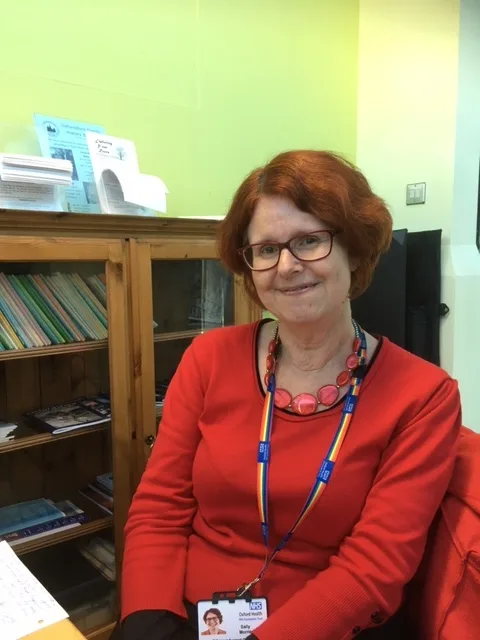
Sally Morris
Interviewed by Julia Buchanan
Biography
Currently, Sally Morris is IT Project Support Officer for Oxford Health NHS Trust. She was interviewed by Julia Buchanan in December 2025. Sally was born in rural Lincolnshire in 1969. After a period working as a bank clerk, Sally decided that she wanted to work for the NHS. She came to the Warneford Hospital in 1990 as a trainee medical secretary. Sally went on to become PA to the Assistant Director of Nursing in the mid-1990s, and later in her career, she worked in Human Resources and workforce planning. Having seen the Warneford site go through so many changes, Sally now looks forward to seeing how the historic Warneford buildings will be adapted and used in the future.
This excerpt
In this excerpt, Sally describes what motivated her to train as a medical secretary at the Warneford Hospital, and also how she felt connected to patients’ experiences through her role of typing letters written by the Warneford doctors.
The full interview
Topics covered in the full interview with Sally include her memories of the Warneford building and grounds, also her involvement through her varied roles in development of clinical practice (including serious incident reviews), staff support, technological innovation, and the development of new services and clinical units. The recording and transcript of the full interview with Sally Morris can be accessed at Oxfordshire Health Archives.
Transcript of audio excerpt
00:04:21 Interviewer (JB)
Did it feel like entering a new world?
00:04:24 Sally Morris
Completely, yes, having worked in banking prior to this, and I hated working in banking, it definitely wasn’t for me, it was a salesman type job and that wasn’t me … I always wanted to do something that was more caring, but I would never have made a very good nurse – I don’t like the sight of blood or anything like that. But I always felt it needed to be something where I felt I was doing my bit, helping people, and so it felt like being a medical secretary, I was actually doing my bit for the NHS. [I] clearly loved it because I’m still in the NHS, however many, 35 years, I think it is later.
00:05:06 Interviewer (JB)
Gosh. And was the world of mental health as distinct from other sorts of health, was that quite new to you?
00:05:17 Sally Morris
Completely … new to me. My family joked with me, why was I joining the NHS? Because I was likely to faint if I saw blood. And they … thought, how could I go and work as a medical secretary? But mental health wasn’t that type of health work, so if I went on the wards there weren’t going to be drips everywhere … [the] patients looked well enough, sort of thing, they didn’t necessarily look ill, so it was fascinating. I very rarely got to see the patients, but it was fascinating writing about them. You felt you got to know them over the, unfortunately over the years, as they would become ill, they would be admitted, then you maybe wouldn’t hear from them or … write the letters to them for a few months, and then they might become ill again.
00:06:06 Sally Morris
So you felt you were getting to know them, sort of thing?
00:06:12 Interviewer (JB)
How interesting and I think, am I right in thinking that Vaughan Thomas ward at that time was for acute admissions?
00:06:22 Sally Morris
Yes, yes it was adult acute admissions both men and women.
00:06:27 Sally Morris
I believe it’s now a single sex ward but back then the Warneford had Vaughan Thomas Ward and Wintle Ward [which] were both adult patients, and Alan Ward was older adult patients, and then there was a child and adolescent unit as well in a slightly different building but on the Warneford site.
00:06:49 Interviewer (JB)
So thinking about those patient stories, how … how did you learn maybe the terminology or get an idea of what it was that they were going through?
00:07:03 Sally Morris
Terminology wise, the…I can’t remember what it stands for … the BNF became my bible, the British National Formulary book, something like that. So that was how we could look up all our drug names, and depending on the accent of the doctors was how well you could actually work out what the drugs were. And obviously you got used to … you gradually learnt that “LFTs” were liver function tests, and all the abbreviations, all the routine tests that they did when people were admitted.
00:07:37 Sally Morris
Sometimes it was quite … a lot of the time, it was quite distressing hearing people struggling sort of thing. Obviously, if you’re suffering from mental health issues, it’s a very bad time in your life. And to write about people, and especially people that … attempted suicide and you were writing [it] up. Sometimes obviously the doctors were quite matter of fact in their letters, maybe to a GP … And that was quite hard to think, I only spoke to that person a couple of weeks ago and she’s back in, she’s done this again or [that] sort of thing. So that was quite … that could be quite hard at times finish .00:08:19