What the Papers Tell Us
From the early nineteenth century onwards, newspapers played a crucial role in informing readers of current and local events; capturing both national and everyday concerns. When the Radcliffe Asylum was established in 1826, the press was already a recognised source of public information. By the mid‑twentieth century, at the height of the newspaper industry in the UK, references to the hospital appeared across a wide range of Oxfordshire publications, from larger county broadsheets through to village periodicals and university papers. These provide a valuable insight into how public attitudes towards the hospital shifted over time, offering a sense of changing perceptions on mental health. Articles regularly appeared covering the ongoing appeal for funds through subscriptions and donations; many thanking existing benefactors and informing the public of the hospital’s objectives and services.
Newspapers also offer glimpses into the everyday workings of the hospital through job advertisements, committee meeting minutes, cricket team results, and horticultural prizes for the roses and vegetables grown on the grounds. Alongside these lighter details are more harrowing stories, including court cases involving past or future patients. The tone of such reporting changes markedly over the decades, reflecting broader shifts in attitudes towards mental illness and those receiving care.
When searching the newspaper archives for references to the hospital, focus was placed primarily on the digitised records available via the British Newspaper Archive.
The four newspapers most frequently sourced were:
Jackson’s Oxford Journal – Digitised availability: 1753–1895, 1899–1928
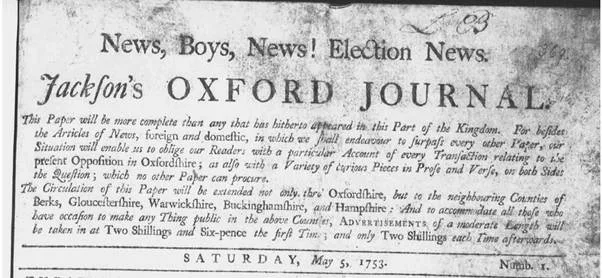
One of Oxford’s earliest newspapers, Jackson’s Oxford Journal, was established in 1753 and produced a weekly edition each Saturday. It remained in circulation for 175 years, with readership reaching around 8,000 by 1882. In 1908 the title changed its name to Oxford Journal Illustrated. With a Conservative stance, the paper set out to cover an assortment of University and Oxford town events, along with a broader overview of national and international news. Its editorial ambition was clear from the first edition, which declared the paper would be “more complete than any that has hitherto appeared in this part of the kingdom.”
Jackson’s Oxford Journal (1753) – ‘News,Boys.News! Election News.’ Jackson’s Oxford Journal Saturday 05 May 1753, P.1. Available at Jack/btis Oxfo Rft Journal. | Oxford Journal | Saturday 05 May 1753 | British Newspaper Archive. [Accessed 09/03/2026].
Content provided by THE BRITISH LIBRARY BOARD. ALL RIGHTS RESERVED.
Oxford University and City Herald – Digitised availability: 1806-1823,1825-1884

The Oxford University and City Herald proved the most detailed source for news relating to the Warneford Hospital. Founded in 1806 and running for 85 years, it was promoted by the University and aimed to serve both academic and local interests. Its first issue offered thanks and reassurance, promising coverage of matters concerning degrees, societies and elections, alongside foreign intelligence, domestic reports, court proceedings, and parliamentary debates. Readers were assured that equal attention would be given to “provincial occurrences,” and that ‘[…] the Oxford University and City Herald will be conducted in the most liberal manner; and that neither expence nor trouble will be spared […] to make it generally useful.’
Oxford University and City Herald (1806) – ‘To The Public’ Oxford University and City, Saturday 31 May 1806. P.1. Available at To The Public. On The Commencement Of A Periodical Pubtica- Tion, It Is Usual, By Way Of Introduction, To Make | Oxford University and City Herald | Saturday 31 May 1806 | British Newspaper Archive. [Accessed 09/03/2026].
Content provided by THE BRITISH LIBRARY BOARD. ALL RIGHTS RESERVED.
Oxford Chronicle and Reading Gazette – Digitised availability: 1837-1892,1894-1896,1898-1909,1912-1929

First published in February 1837, the Oxford City & County Chronicle, later named the Oxford Chronicle and Reading Gazette, positioned itself as a non‑political and honest newspaper, committed to presenting facts and opinions without exaggeration. Although early issues leaned towards a liberal perspective, the paper offered a clear and steady account of local and national events, appealing particularly to Oxford’s townspeople rather than the University.
Oxford Chronicle and Reading Gazette (1837) ‘Address to the Public’ Oxford Chronicle and Reading Gazette, 04 February 1837, P.1. Available at Remareably Cheap Ohn Bryant, Toracconistr, &c Oriel Street Oxford Wellington House, Egs To Inform His Friends and The Public Waterloo | Oxford Chronicle and Reading Gazette | Saturday 04 February 1837 | British Newspaper Archive. [Accessed 09/03/2026].
Content provided by THE BRITISH LIBRARY BOARD. ALL RIGHTS RESERVED.
Oxford Times – Digitised availability: 1862-1896,1898,1900-1910,1913-1918

Founded in September 1862 as The Oxford Times: And Midland Counties Advertiser, this weekly broadsheet opened each issue with advertisements and notices from local businesses before turning to news from Oxford and the surrounding area. It also provided summaries of national and international events. With a long and varied history, The Oxford Times continues to thrive today, reaching a substantial 30 million online readership.
Oxford Times (1862), ‘Henry Purdue & Co.’ Oxford Times, Saturday 13 September 1862, P.1. Available at and | Oxford Times | Saturday 13 September 1862 | British Newspaper Archive. [Accessed 09/03/2026].
Content provided by THE BRITISH LIBRARY BOARD. ALL RIGHTS RESERVED.
